THE ENGINEERING CASE
One Fractured Tooth. Six Figures of Crusher Damage.
A bucket tooth failure is rarely just a maintenance event. In most mining and quarrying operations, the excavation system feeds directly — or nearly directly — into a primary crusher. A fractured tooth fragment entering that crusher can cause a level of mechanical damage that shutdowns an entire processing line for days.
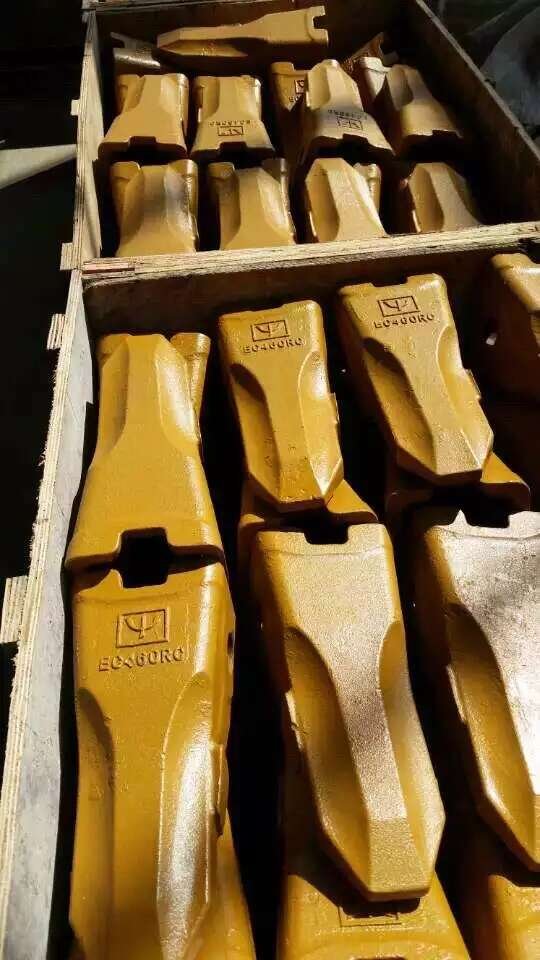
This is why our zero-failure policy on bucket teeth is not a marketing claim — it is an operational necessity. Every single bucket tooth and adapter we supply is individually tested using 100% ultrasonic testing (UT) and magnetic particle inspection (MT) before it leaves the facility. Not sampled. Not batch-tested. Every piece.
We then back this with precision investment casting under vacuum conditions, which eliminates the porosity and shrinkage voids that are the primary cause of unexpected fracture in conventionally cast teeth.
MANUFACTURING PROCESS
Why Vacuum Casting Changes Everything.
Conventional sand casting is adequate for many applications. For bucket teeth subjected to high-impact, high-stress loading in aggressive ground conditions, it introduces an unacceptable risk of internal voids — subsurface defects that are invisible to visual inspection and undetectable without NDT, but which dramatically reduce the tooth’s resistance to fracture under load.
Vacuum investment casting eliminates this failure mode by removing atmospheric gases from the molten metal during pour. The result is a dense, void-free casting with mechanical properties that match — and often exceed — those of the design specification.
Combined with FEA (Finite Element Analysis) optimized tooth profiles, this process allows us to engineer maximum penetration force at the tip while distributing stress away from the adapter connection — the most mechanically vulnerable zone in any G.E.T. system.
Process Steps:
- Wax pattern production (precision tool)
- Ceramic shell investment
- Dewaxing and shell preparation
- Vacuum-assisted casting pour
- Shell removal and initial inspection
- Heat treatment (hardening + tempering)
- 100% NDT (UT + MT)
- CMM dimensional verification
- Surface treatment and marking
- Individual component certification
OEM Compatibility and Custom Engineering.
Standard OEM-Compatible Range:
| Application | Compatible Models (Examples) |
| Large Mining Excavators | CAT 390 · Komatsu PC800 · Hitachi EX1200 |
| Mid-Size Excavators | CAT 336 · Komatsu PC360 · Volvo EC380 |
| Wheel Loaders | CAT 988 · Komatsu WA500 · LiuGong 856H |
| Dozers & Scrapers | CAT D10 · Komatsu D155 |
| Custom Applications | Provided on request with drawing/sample |
Tooth Profiles:
- Rock Point — hard rock, high penetration
- Tiger Point — abrasive ground, self-sharpening
- Flat Top — loose material, high volume
- Twin Tiger — extreme abrasion environments
- Custom profiles engineered from wear data
Alloy Grades:
- Standard: 20MnCr, 30MnCr
- Premium: Proprietary high-strength alloy (available on request)
THE 100% NDT COMMITMENT
Heading: Individual Testing. No Exceptions.
Ultrasonic Testing (UT) Sound waves are transmitted through each component and reflected from internal surfaces. Voids, inclusions, and subsurface cracks appear as anomalies in the return signal. Every tooth and adapter is individually scanned — not sampled.
Magnetic Particle Inspection (MT) A magnetic field is applied to the component surface, and magnetic particles are used to reveal surface and near-surface discontinuities. Particularly effective at identifying heat treatment cracks and surface-breaking defects.
Individual Certification Every component that passes NDT is marked with a batch and item identifier and issued individual certification documentation. You receive a full traceability report with every shipment — mapping each piece to its chemical batch, heat treatment record, and NDT result.