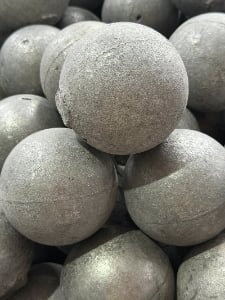
High Chrome Grinding Balls
THE METALLURGICAL CASE Why Chrome Content Is Not Enough. Most suppliers sell chromium percentage. We engineer the complete metallurgical profile...
View Technical SpecsIn cement grinding circuits, the grinding media specification directly determines energy consumption, wear rate, and product fineness. Alliance supplies high-chrome grinding media matched to your cement type, mill design, and target Blaine — under the quality protocol trusted by some of the world's most demanding industrial buyers.
14–22%
CR CONTENT RANGE
Ø20–90mm
DIAMETER RANGE
Tier-1
AUDIT VERIFIED
≤0.5%
BREAKAGE RATE
Cement grinding is a controlled, high-volume, energy-intensive process. Unlike mining applications where ore variability allows some flexibility, cement grinding circuits operate within tight parameters that demand consistent, predictable media behavior.
≤0.5%
BREAKAGE RATE
Tier-1
QUALITY VERIFIED
Cement grinding is a controlled, high-volume, energy-intensive process. Unlike mining applications where ore variability allows some flexibility in media performance, cement grinding circuits operate within tight process parameters — target Blaine, specific surface area, clinker hardness — that demand consistent, predictable media behavior.
A grinding ball that varies in hardness from batch to batch produces an inconsistent wear rate, which means inconsistent charge dynamics, which means inconsistent fineness — and inconsistent cement quality. The cost of that inconsistency in a cement plant is measured in both product quality and energy efficiency.
APG MINEX manages batch consistency as a primary output of our quality system. The same Rockwell hardness mapping protocol that satisfies Tier-1 mining auditors applies directly to cement media supply — because consistency is the point.
Chamber 1 — Coarse Grinding
Chamber 2 — Fine Grinding
Ball Charge Optimization We don’t just supply balls — we develop the charge ratio recommendation for each chamber based on your mill dimensions, rotation speed, target Blaine, and clinker hardness index. The charge ratio is as important as the ball specification; most cement plants have never had an independent audit of theirs.
Predictable Wear Rates Consistent hardness = consistent wear = predictable recharge schedules. No surprises in your consumables budget. No unexpected charge top-up requirements mid-campaign.
Stable Energy Consumption A consistent grinding charge with predictable wear characteristics allows stable mill optimization. Energy consumption per ton of cement ground becomes a manageable number, not a variable.
Quality Compliance For cement manufacturers supplying to infrastructure projects with quality certifications, media consistency contributes directly to the consistency of the product. Our batch traceability system provides documentation support for your own QC requirements.
Each product below is selected for its wear mechanism compatibility with this operating environment -- not as a catalog listing.
THE METALLURGICAL CASE Why Chrome Content Is Not Enough. Most suppliers sell chromium percentage. We engineer the complete metallurgical profile...
View Technical Specs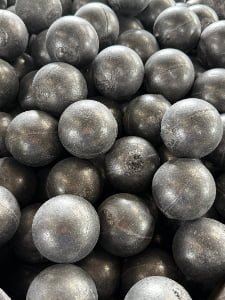
WHY FORGING MATTERS Casting Creates Balls. Forging Creates Performance. The mechanical difference between a cast and a forged grinding ball...
View Technical Specs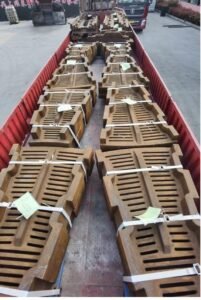
THE INTEGRATION PRINCIPLE You Can't Optimize One Half of the Circuit. The grinding media and the mill liner are not...
View Technical Specs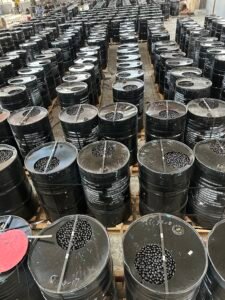
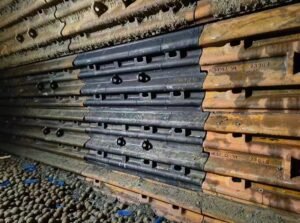
Unplanned downtime in this industry does not cost time -- it costs production tonnage, equipment integrity, and contractual commitments to downstream customers. A single missed shipment of wear parts can cascade into multi-day mill stoppages.
Our supply continuity model is built around scheduled replenishment cycles, pre-qualified buffer stock protocols, and logistics routing that accounts for port congestion and seasonal freight variability. We do not treat delivery as a final step -- we treat it as a managed engineering variable.
Mill diameter, length, rotation speed, chamber configuration, target Blaine, and clinker hardness. Send us the data and we'll develop a matched media specification with a cost-per-ton projection.
Bring your current supplier data, wear life records, or failure analysis. The more operational context you share, the more precise our technical recommendation will be.
NDA Available on Request · IP Protected